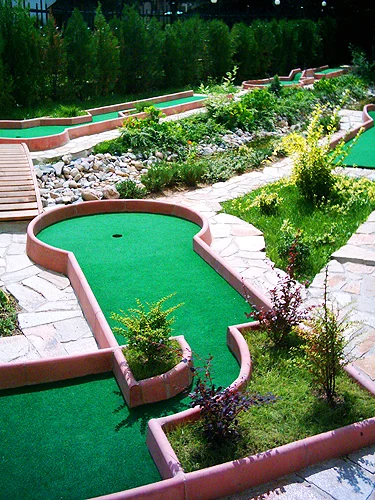
Minigolf is not a mere Sunday game, played by vacationers who want to stay out and enjoy the nice summer weather. Minigolf is also a multifaceted and challenging competing sport.
Every year a World Championship or European Championship tournament is arranged by World Minigolfsport Federation. More than one hundred top-class minigolfers from fifteen to twenty countries participate in these yearly highlights of minigolf sport, where success is only possible after years of intensive practice and study of the game. Both men and women compete in the international tournaments, each gender in their own categories.
The most important factor in playing minigolf is not physical strength, but the ability to concentrate and control one’s mind. The appeal of the game is mainly in mental exercise, rather than physical.
TRACKS
Minigolf is played on 18 tracks, the length of which varies between 6 and 18 meters, and width between 0.80 and 1.25 meters.
There are three different surface materials for official tournament tracks: felt, beton, and eternite. (Eternite is hardened beton. In the past they used to produce it by mixing asbestos with beton, but nowadays the asbestos has been replaced by other materials.)
Felt is the most common track material in Scandinavia, while beton and eternite are more common in Central and Southern Europe. In America or Asia one might even encounter grass tracks, but they are not suitable for international tournament use.
The balls used in minigolf do not have similar “pits” on their surface as golf balls have. In big golf the purpose of the uneven surface is to give the ball the best possible aerodynamic qualities. In minigolf no special aerodynamic qualities are needed, but rather a smooth surface which provides the best control on an even base.
Minigolf balls are manufactured of PVC plastics or artificial rubber, and they are varnished with acryl or other kinds of lacquers.
If golf is played with one kind of a ball and several different clubs, in minigolf the setting is vice versa: the player has only one club, but the ball to be used on a track is picked from a selection of tens or even hundreds of different options! The most important qualities of a ball are bounce height, hardness, and weight. Also the different surface treatments (lacquered, non-lacquered, roughened) affect the way how a ball behaves on the track. The diameter of balls varies between 35 and 43 mm on felt, and between 37 and 43 mm on eternite and beton.
On felt one does not necessarily need too many balls. For a beginner it is enough to have one “all-round ball”, for example Wagner 37 (bounce 5 cm, hardness 60, weight 40 g). Later on the selection can be expanded with a Clicker, also called “Stone” or “Isolon” (bounce 80 cm, hardness 100, weight 40 g), a ball of the type “H 3” (20 cm, 60 hd, 40 g), and a ball of the type “H 1” (14 cm, 60 hd, 40 g). With these five balls it is possible to win practically any tournament on felt!
On eternite and beton more balls are needed, and it is not rare that someone uses fifteen balls on a round of eighteen tracks. Because of the great number of different balls and playing strategies, playing eternite or beton should be started together with experienced players.
An enthusiastic minigolfer may own several hundreds of balls, which are stored in special ball bags of roughly 100 balls each. A large ball selection is a benefit on eternite and beton, but on felt it is wise to keep the number of the balls used on a round in the minimum, not to lose one’s delicate force touch during the round.
The balls needed on a round should be preserved in stabile temperature, not to get any unwanted surprises when the qualities of the balls change as the weather gets warmer or colder. There are special thermo-bags on the market, which isolate the balls from the temperature conditions around the bag. On hot weather minigolf balls must be kept in shade, and on cold weather they perhaps need to be warmed in one’s pocket.
A player does not necessarily need to own more than three or four most commonly used balls. Special balls, which are only used on one or two tracks, are circulated among the players, so that all use the same ball. Borrowing and lending balls may feel irritating when practising, but this cooperation is very beneficial in tournaments, as one will be able to observe the behaviour of the ball while others play with it. Thus such accidents are less likely to occur that a ball gets all too cold or all too hot in the bag while no one uses it for an hour or two.
When you buy a ball, always check that the ball is absolutely round. Minigolf shops sell roundness testers, and if you don’t happen to have one at hand when buying a ball, you can try to test the roundness by spinning the ball on the table like a top. A misshapen or eccentric ball shakes a bit while spinning. (It is possible that a ball is absolutely round but still eccentric, and thus unsuitable for tournament use.)
A new lacquered ball usually has a small pin trace on its surface – the spot where the ball was held when it was varnished. Remove the pin trace immediately after buying the ball, for example with sandpaper or a needle file. Be careful not to harm the lacquer around the pin trace.
It is possible to “peel” a ball (that is, remove the lacquer) with acetone, for example with nail polish remover. It is also possible to varnish a non-lacquered ball at home, if one consults a hobby shop when choosing a suitable lacquer. However, in top-class competition the quality requirements for balls are so strict that it is better to buy new balls with the preferred qualities from a minigolf shop.
Before you take your newly-bought balls to the local minigolf course, it is wise to mark your initials on them with a permanent marker. This makes recognizing your own property easier, so that your balls will not get mixed up with the playing equipment of the other players.
CLUB
The club used in minigolf is similar to a golf putter. Special clubs are manufactured exclusively for minigolf, but they don’t differ much from “real” golf putters . Some minigolfers prefer a wider club angle than the 115 grades of standard golf putters: If there is only a regular golf putter at hand, hammering the club angle into the preferred position is no big problem… but use the hammer gently, not to destroy the putter!
Acquire a club of high quality right away: don’t say that the difference between a good club and a bad one cannot be traced from your shots. One day the difference will be visible, and changing the club may become a long struggle.
The length of minigolf clubs varies according to the tallness and stance of players. Short junior clubs are available if you need one, but most players buy a full-length club and use an iron saw if the need arises. A child naturally cannot use a full-length club that sticks one’s stomach all the time. But using an unnecessarily short club is not recommendable either, as one will need more muscle power in playing the strokes. The standard length of golf putters is the optimal solution for maximal control of both the force and direction of the strokes.
The handle of the club must fit your hands perfectly: if the standard handle feels uncomfortable, make a better one yourself. It is probably a good idea to cover the handle with similar grip as they use on tennis rackets. If the standard handle gets too thick with the grip, you must cut it thinner with a knife.
The steel head of a golf putter is not as such suitable for playing minigolf: the different balls used in minigolf would be very difficult to control with a steel club. For this reason a rubber plate 4 – 12 mm thick is attached to the head of the club. It gives the player approximately similar control on all the different ball types, and also adds some force to the shot.
The rubber plates vary in elasticity and thickness. These qualities affect the control of force and spin: a very thick and soft rubber plate will make it easy to play powerful spinless shots, while a thin and less elastic rubber plate gives one maximal control of the delicate spin shots. In theory a thin rubber might be an advantage on eternite, and a thick one on felt tracks. But if you plan to play on all the different track types, it is advisable to avoid any extremities.
The rubber plate is attached to the club-head with contact glue or double-face tape. Only spread as thin a layer of glue as possible on the surfaces, and then press the pieces forcefully together. If you use too much glue, it is possible that it spreads unevenly under the rubber, and the rubber becomes slightly crooked. Being careless when gluing the rubber is the worst possible way to begin one’s career as a minigolfer. I personally recommend double-face tape for everyone.
During transportation the club or at least its head should be protected, as the club-head is the most important and vulnerable part of your playing equipment. Remember to check the condition of the club-head and rubber from time to time. If it gets harmed, that will certainly affect your performance on the minigolf course.
As an accessory it is possible to acquire a suction cup into the upper end of the handle, with which it is easy to pick the ball from the hole. Using a suction cup is not allowed in tournaments, though, except on medical grounds.