TECHNIQUE
One thing about minigolfers’ playing techniques must be mentioned right away: there are no two players with a similar technique. The game does not require much use of force, and therefore one is not absolutely bound to apply the theoretically most efficient techniques. Each player can choose the playing method which best fits his own bodily structure and personality.
GRIP
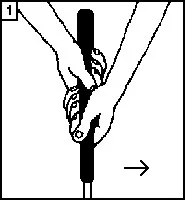
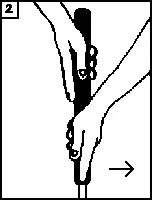
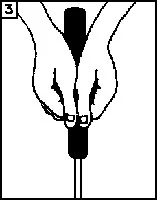
There are three different basic grips to choose from: backhand, forehand, and overlap grip. Pictures 1 and 2 above show backhand grips, if the shots are played into the direction of the arrows. If the shots were played into the opposite direction, then these would be forehand grips. Picture 3 shows an overlap grip.
The backhand grip in picture 1 is clearly the most common grip used by minigolfers. It gives you firm control of the club, and requires little movement of the upper body when playing a shot, as the muscles of your arms take their share of the physical effort of the stroke.
The grip in picture 2 requires much more movement of the upper body, as one’s hands are not doing much more than holding the club and staying rigid. This is no great problem on eternite, where the shots involve very little use of force, but on beton and especially on felt the grip might be a disadvantage.
Compared to the backhand grips, the forehand versions of grips 1 and 2 (the direction of the shot now being to the left) involve slightly different muscles of the body in playing a stroke. Some of the work done by the upper body in the backhand versions gets transferred into one’s arms – namely the arm of the lower hand. The possible disadvantages of this will only be encountered in the most powerful strokes – that is, mainly on felt.
The overlap grip, shown in picture 3, is the least recommendable one. In it the outer hand holds the inner hand instead of the shaft of the club, which is great waste! This grip requires one to press one’s hands very tightly together, in order to keep the club in balance.
In any of the grips it is possible to keep one or two of one’s forefingers straight, as seen in picture 2. Some players feel that this helps them to better control the balance of the club.
Players with different bodily structures naturally prefer different grips, but generally it is advisable to first try the backhand version of grip 1. It probably gives one the best overall control of the different shots, both the gentle and the powerful ones.
Only do not force your fingers to stretch into impossible positions! Your grip should feel comfortable, as you will need it quite a few times during your playing career…
STANCE
Some of the different stances encountered among minigolf players may at first sight look a bit weird, if one compares them to the classic putting stance of big golf. The special characteristics of minigolf require some adjustments to the playing stance.
Again it must be stated that a “one and only” orthodox style does not exist: the tallness, age, and weight of the players affect the choices of stance. (In minigolf one is not bound to have the bodily shape of an athlete in order to reach the international top level. As I mentioned in the preface, the key factor to success is mental abilities, not physical strength.)
Let us take a glance at the different parts of the playing stance of minigolf, keeping an eye on the theoretical advantages and disadvantages of the alternatives.
Position of feet:
In the classic putting stance of golf one’s feet are some 30 cm apart from each other, pointing straight ahead. This position of feet is very common among minigolfers as well. One can hardly keep one’s legs closer to each other than this, because one needs to stay well balanced during the stroke.
Many players prefer a wider stance, with one’s feet up to 90 cm (!) apart from each other. This brings some changes to the muscular activity of the body: the physical work will now be done almost exclusively by the arms and the upper body, while the legs stay fairly passive. (In fact a wide stance makes it possible to do vice versa as well, keeping one’s arms passive and doing all the muscular work with one’s legs. But this certainly is not recommendable: there would be too many “moving parts” between the club and the muscles which control the stroke.)
Trying to limit the muscular activity mainly into one’s arms and the upper body is a recommendable idea – at least in the more gentle shots (on eternite). In the classical narrow stance one’s whole body moves during the stroke, as one’s sense of balance will automatically and unconsciously interfere in the action. The player is not necessarily in full control of all the movements of his body, as the sense of balance functions independetly of one’s consciousness. There is a danger that the sense of balance will interfere in the bodily movements at a slightly different phase of the stroke at different times, which might cause some irregularity to the strokes.
Asymmetric “forward” stances, in which one’s body is turned slightly into the direction of the shot, always involve less bodily movement at the early stages of a stroke than the corresponding symmetrical stances. A wide asymmetric stance includes least “moving parts”, and thus theoretically provides most regularity to the strokes.
However, in powerful shots (that is, on felt) it is not necessarily a good idea to have as few “moving parts” as possible. Doing all the work with one’s muscles sounds easily controllable, but in fact your muscles are not easy to control when they do very heavy work! Playing felt is light children’s game if you compare it with big golf, but still it requires enough use of force to demand at least a brief look into the teachings of golfers: wide swing, feet close to each other, upper body in rotation. These magic words might be useful especially if your bodily structure is not that of a 20-year-old athlete.
Club angle:
The angle of your club should fit your stance: when you have decided which kind of a stance to use, you ought to bend the club-head into a corresponding angle – or more preferably, choose a club with the right angle already in the shop. If the club-head does not rest horizontally on the track while you are sighting, the risk of a poor hit to the ball increases. Your club may either hit the ball too high, or then swing too low and hit the track, which both options give a bad result.
The club angles of minigolfers vary between 90 and 130 grades. The wider the angle is, the wider will the swing of the stroke be, which gives more force to the stroke with the same muscular work. On eternite a wide club angle makes it easy to reach the ball on the track, as players are not allowed to step on eternite tracks.
However, on felt and especially on beton there is not too much room on the base on which the player stands. With too wide a club angle (or a very wide playing stance) one will encounter certain problems on these track types. A relatively sharp club angle probably feels most comfortable on beton and felt – and being comfortable is always a step towards being reliable and successful.
A sharp angle has yet another benefit: one’s back does not have to bend too low down. Thus the playing stance will be less straining, and it will be easier to endure the physical stress of a long tournament. Especially the elder players will find this an important detail.
The standard club angle of around 115 grades is a recommendable starting point for anyone. The exact angle to be chosen depends on your grip and stance.
General advice:
Whatever your club angle is, and in whichever position you decide to keep your feet, make sure that your heels stay firmly on the ground during the stroke. If you feel tempted to lift one of your heels in the air after the club has hit the ball, your stance probably is not stable enough to make success possible on top level. Try a different position of feet – perhaps an asymmetric one.
Make sure that your legs are slightly bent all the time, so that the weight of your body rests on the muscles and not on “locked” joints! Your muscles must have active control of your bodily movements and balance. But don’t bend your legs too much, so that your muscles will become tired after an hour or two at the minigolf course.
When you have an established stance, adjust your club angle to fit your stance.
SIGHTING
How does one aim in minigolf? Does one need an inhumane ability to see when the club-head is exactly in a 90 degrees angle across the line of the shot? Or does one need a sixth sense, or what?
Let us first consider some other sports, and examine how the players aim in them.
A tennis player, how does he aim? When the ball is coming towards him high up in the air, does he fix his eyes to his racket, and try to make sure that it is exactly in the right position? No. He does not even notice his racket: he looks at the other side of the field, searching a suitable spot to play the ball at, and then he makes the shot… without even looking at his racket! His playing technique is so automatic that all he needs to worry about when sighting is choosing the best possible target to play the shot at.
Well, how about baseball then? When the batter sees the ball coming towards him, does he look at his bat and start calculating a suitable angle at which the bat should hit the ball? No. He only looks at the players of the opposing team, searching a suitable gap to play the ball into, and then hits the ball… without ever looking at his bat! There is no time for calculating the right angles for the bat: such details of the playing technique must be automatic, if one dreams of becoming a champion in the sport.
So, how does one aim in minigolf?
As a beginner you indeed must all the time look at the club-head and worry about its angle. You must try to point the club at the target which you are aiming at. You must use all your concentration for the task of getting the club-head into the right position, constantly worrying that you perhaps misinterpretate the position of the club. You are a beginner. Your sighting is not automatic.
But when you get more experience of the game, all the parts of your playing technique will become more and more automatic and unconscious, including sighting. You will become like the tennis player, only looking at the field, finding a suitable target to aim at, and you begin to forget that you indeed have a club in your hands! You and the playing equipment are one. (Okay, you are not really one with the equipment… but if you wish to become a national or international champion, you must realize that this is the goal to pursue: playing must feel as natural as if you had no equipment at all in your hands! It only takes some practice…)
Let us now analyze the details of sighting, in order to find out what it is that you are soon about to do unconsciously and automatically.
There are several ways how to aim a shot. The easiest one – the one used by beginners – is to look at the club-head and see if it is parallel with the line behind the start spots on eternite or felt tracks. Simple: when the club-head is exactly parallel with the line, then the shot is going to be straight. The greatest problem with this sighting technique is that not all the strokes are played straight according to the line – and not all the strokes are played from the start spots at all! You can decide that you aim “a bit into that direction” from the line, but the accuracy of such sighting is not breathtakingly infinite.
Another option is to choose a mark some 20 cm ahead of the ball and aim at it. (First making sure that the mark is exactly on the line between the ball and the target which you are wishing to hit.) This sighting technique already requires one to determine when the club-head is in a 90 degrees angle across the line of the shot. It may feel difficult in the beginning, but there is no reason to be worried: after a while you will not notice at all that your brain is thinking about any angles when you are sighting! Only remember that it is forbidden to make any own marks to the tracks: you must use the stains and dots already found on the track.
The next level of sighting is already the final stage: looking at any point on the track, either near or far, and unconsciously adjusting one’s playing position and club angle for the shot. Just like the tennis player. In order to learn this, you don’t have to be an exceptional natural talent: all you have to do is play the game enough. The rest will be arranged by the natural talents which you have never even noticed in yourself…
In what way is this “long-range” sighting better than the first two options mentioned above (looking at the line, or looking at a spot 20 cm away)? To begin with, sighting at a target several meters away from the player is theoretically more accurate than the two “close-up” options. If you have ever tried to shoot with a handgun at rifle targets, you know what a huge difference there is in sighting along a barrel 20 cm long or a barrel 100 cm long. The sight of a handgun is simply too short: hitting the center of a rifle target is a hopeless task! In the same way, sighting in minigolf at a spot 20 cm ahead of the ball is less accurate than sighting at a spot that is two or three meters ahead. The 20 cm long sight may well be accurate enough for getting the ball into the hole, but as your physical action is more or less irregular as well, it is possible that the slight inaccuracy of your sighting technique every now and then costs you a point or two.
Another advantage of “long-range” sighting is that it can be used in all possible situations, both when playing the first shot from the start spots, and when putting somewhere along the track. Outside the start area there are no lines to look at, although there may be enough spots to use for close-up sighting.
Whenever possible, combine two or even three of these different sighting techniques when you practice a track for competition. If you use “long-range” or “20 cm” sighting as your primary method, and for some reason you happen to make a mistake with your your primary sighting technique, it may happen that at the last moment before playing the shot you notice that the club-head is not at the usual angle against the line behind start spots (on felt and eternite). Although you are not using the “beginners’ aiming technique” as your primary method, using it as backup may sometimes warn you of an error which you have made with your primary sighting technique… before it’s too late and you play the shot.
You should learn to begin sighting already before you have taken your playing stance, so that your playing position will be exactly the optimal for the direction of the shot. This means that you will not have a different spin in every second shot you make, or a slightly different direction. (Having your feet in different positions may cause your strokes to have different spins!) You will hit the target with the best accuracy that your body can physically perform.
When your sighting technique stops failing from time to time and causing unforced errors, only then you will be able to make the best possible results which you physically could achieve.
STRIKING THE BALL
Now that you have a solid stance and a well-oiled sighting technique, why don’t you go and hit the ball?
Stroke is a turn of the upper body, in which one’s legs take part more or less. It is a bad idea to move one’s legs too much: “too many moving parts” means “too little control”.
When you start drawing the club backwards, your sight is fixed to the place behind the ball where the club used to be while you were sighting. After the club has hit the ball, your eyes follow the club-head forward and upwards. (This is approximately how it goes. You shouldn’t bother your mind too much with the question where to look at, when and why.)
The follow-through is an important part of the shot. Don’t stop the movement of the club immediately after hitting the ball, but let the swing continue in a relaxed way. But don’t exaggerate this either: don’t concentrate on the follow-through, but concentrate on the shot itself!
A relatively common habit is to perform some swings with the club before making the shot, either over the ball, beside it, or behind it. In this way one is able to check that there is nothing remarkably wrong in the playing stance. This action is called “feathering” – and it is (usually) done before sighting.
The comments of your fellow-players about your playing style may be valuable. As it is, you cannot yourself see how firm your stance, follow-through, etc. look like. When greater changes are in question, make sure that the person offering the advice really is an expert.
..