Business figures and historical examples in this guide are illustrative. Your results depend on your location, visitor demand, costs and operation; request current local quotations before making investment decisions.
Mini Golf as a Business: A Practical Guide for Entrepreneurs Starting a Course
Mini golf is one of the few leisure businesses an entrepreneur can start with a small footprint, a modest budget, and no specialist staff. It needs no lifeguard, no power supply, and — depending on the format you choose — no construction at all. This guide explains what a first-time operator needs to know before opening a course: how much space it really takes, which format matches your budget and site, how the courses hold up outdoors, and what it takes to go from empty plot to paying customers.
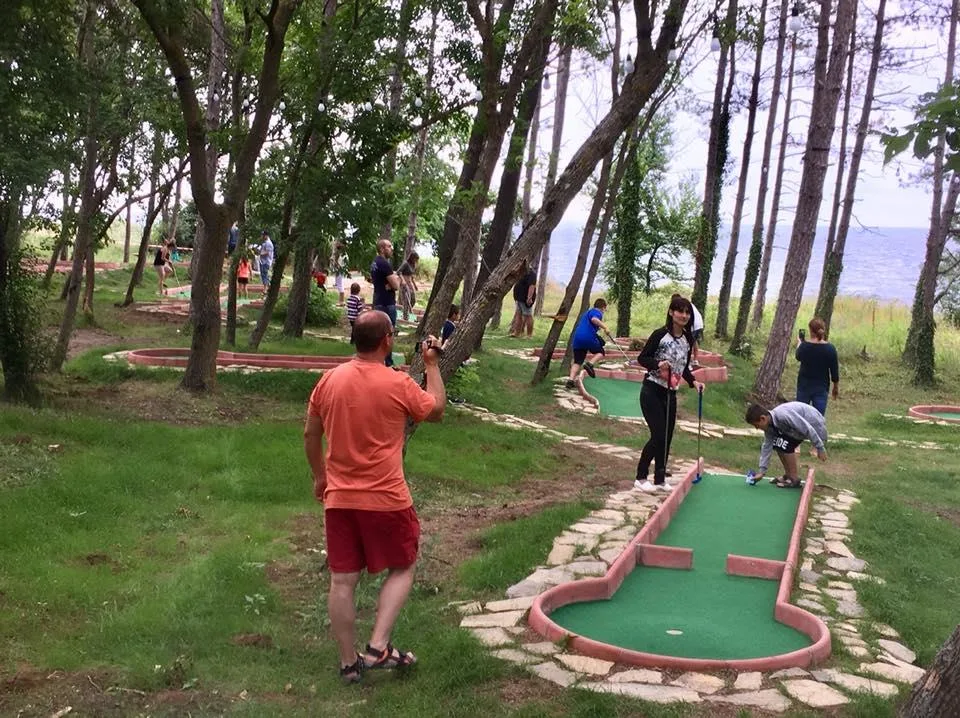
A permanent course built into a wooded plot near the coast — mini golf can turn almost any modest plot into a paying attraction.
Why Mini Golf Is a Good Business to Start
Mini golf sits in a rare sweet spot for a small operator: low startup complexity, low ongoing overhead, and a product that appeals to almost every visitor regardless of age or ability. It doesn’t require a licensed operator, specialist training, or expensive machinery to run day to day — once a course is installed, a single person can manage admissions, equipment, and basic upkeep.
- Low staffing — one attendant can run a whole course, handing out putters and balls and collecting the fee.
- Broad appeal — a single course serves families, couples, tourists, and corporate groups, with no seasonal ceiling on who can play.
- Fast to open — portable formats can be delivered, installed, and taking paying customers within weeks, not months.
- Scalable — a small operator can start with a compact portable course and expand later, or add a second course at a different location once the first proves itself.
- Flexible venue types — a standalone lot, a corner of an existing entertainment complex, a rooftop, a beach concession, or a rented plot near a tourist attraction can all work.
- Repeat, walk-in traffic — no booking system is required; visitors can pay and play on the spot, which keeps overhead and admin low.
Because several course formats exist at very different scales, an entrepreneur isn’t locked into one investment size. A single compact course can test a location and prove demand before committing to a larger, permanent build — reducing the risk of the first move.
Which Course Format Fits Your Budget and Site
Choosing the right starting format is largely a question of how much space you can secure, how permanent you want the installation to be, and how much risk you’re willing to take on a new location. Six formats cover the realistic range from a first small venture to a flagship attraction.
| Course format | Footprint needed | Setup | Best suited to |
| Portable wooden 9-hole | From ~30 m² | Freestanding lanes, no groundworks | Small pitches, terraces, seasonal parks |
| Portable metal 9-hole | From ~200 m² | Galvanised lanes with adjustable levelling feet | Grass, sand, gravel — anywhere uneven |
| Larger portable 9-hole (~96 m²) | ~96 m² | Wider lanes, more spacious layout | Sites with a bit more room to spare |
| Permanent 9-hole | From ~250–350 m² | Built-in obstacles, artificial turf, edging | Sites wanting a fixed, year-round attraction |
| Permanent 18-hole | From ~600 m² | Full-scale built course, two loops of nine | Larger sites and multi-attraction venues |
| Landscape-style “real golf” 9-hole | ~1,900–3,200 m² | Contoured greens, ponds, planting, winding paths | Flagship, destination-level attractions |
Portable wooden courses — the lowest-risk way to start
The smallest format needs as little as 30 m² for a full 9 holes, with each lane roughly 3 metres long. It is fully weatherproof, built for outdoor use, and requires zero groundworks — the lanes simply sit on any reasonably flat surface: a rented terrace, a corner of a shopping precinct, a market square, or a spot next to another leisure venue. For a first-time operator, this is the easiest way to test whether a location has enough foot traffic before committing to anything permanent. Despite the compact size, each lane is designed with an obstacle that keeps the game genuinely challenging rather than trivial.
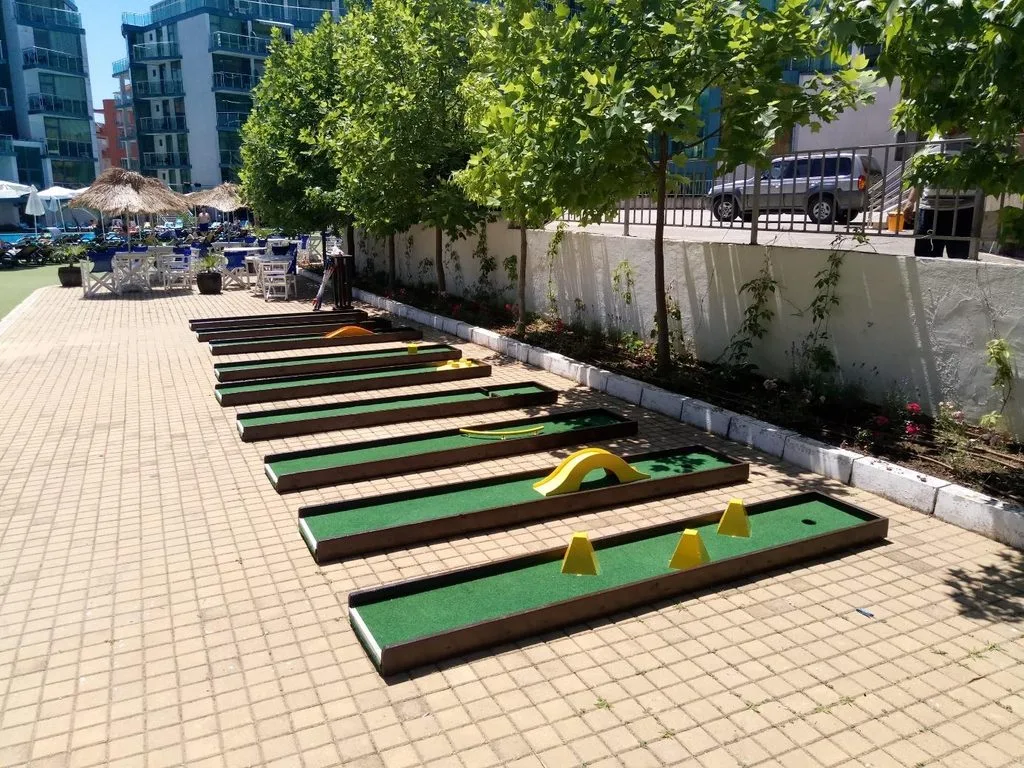
A portable wooden 9-hole course — a low-commitment way to open in a small footprint and start taking paying customers.
Portable metal courses — built for grass, sand, and uneven ground
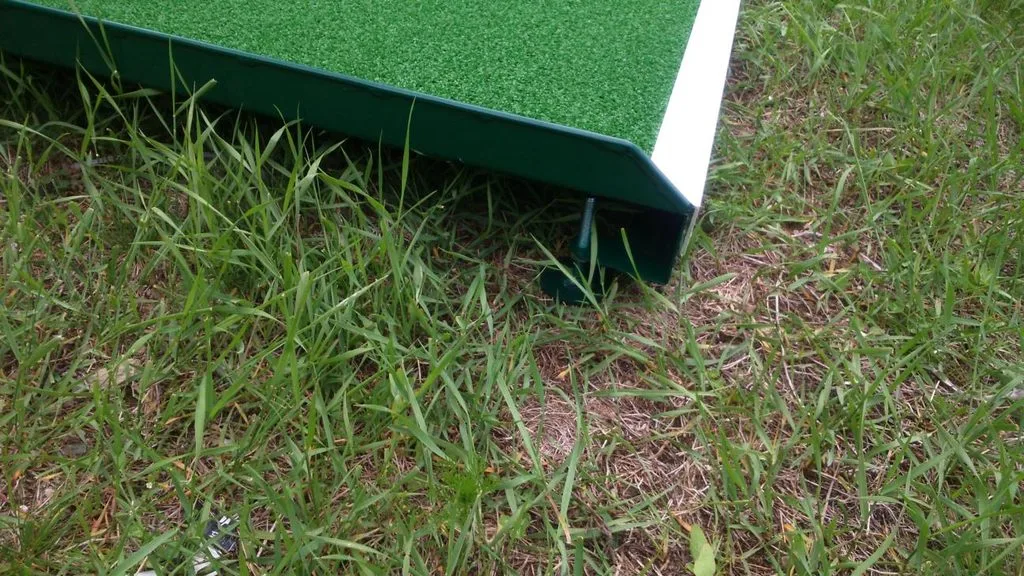
Where a site is grassy, sandy, or simply not perfectly level — common with rented plots and undeveloped land — the galvanised metal format is the better fit. Each lane comes with an adjustable levelling foot, so the course can be placed directly on lawn, gravel, or a beach area and still sit dead level for play — without a single spade of groundwork. That matters for an entrepreneur working with a leased site, since nothing is permanently altered and the course can be relocated if the lease or the location doesn’t work out. The metal construction is fully weatherproof and holds up to being watered along with the surrounding lawn.
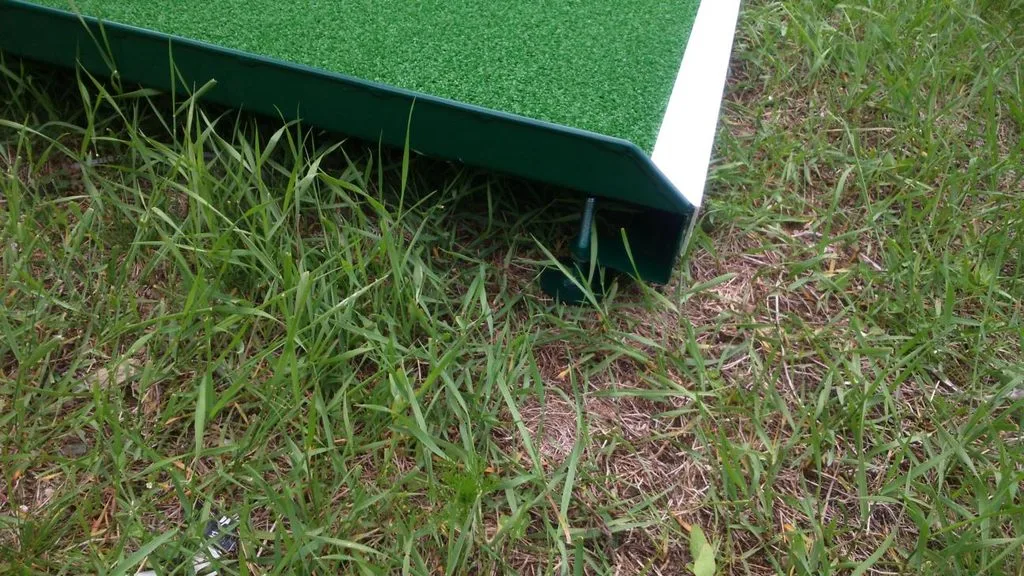
Adjustable levelling feet let a metal lane sit level on grass — set up directly on turf with no groundworks required.
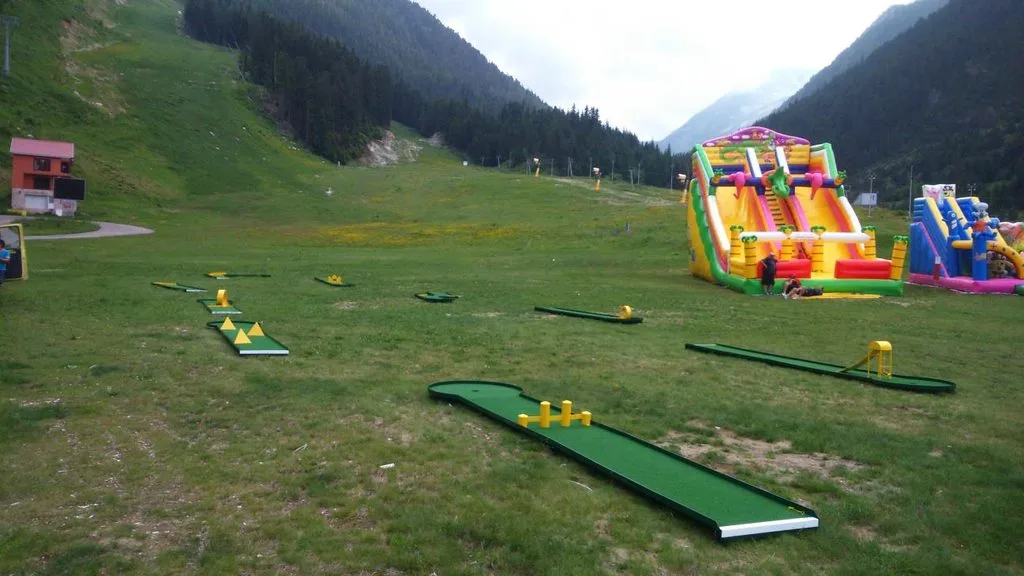
A portable metal course set up on an open meadow — well suited to a seasonal pitch or a leased plot with other leisure attractions nearby.
Metal lanes can be themed and installed directly on sand — a popular option for beachfront concessions and seasonal pitches.
Permanent courses — once a location is proven
For an operator who has tested a location and wants to commit to it long term, the 9-hole and 18-hole permanent formats are built in place: concrete or built-up lanes, artificial turf, and integrated obstacles designed to the standards used by international minigolf federations. A permanent 9-hole course needs roughly 250–350 m², while an 18-hole course needs around 600 m² or more. These courses are engineered for continuous outdoor use and require very little upkeep beyond routine care of the turf — a durable, low-maintenance asset once the location is confirmed to work.
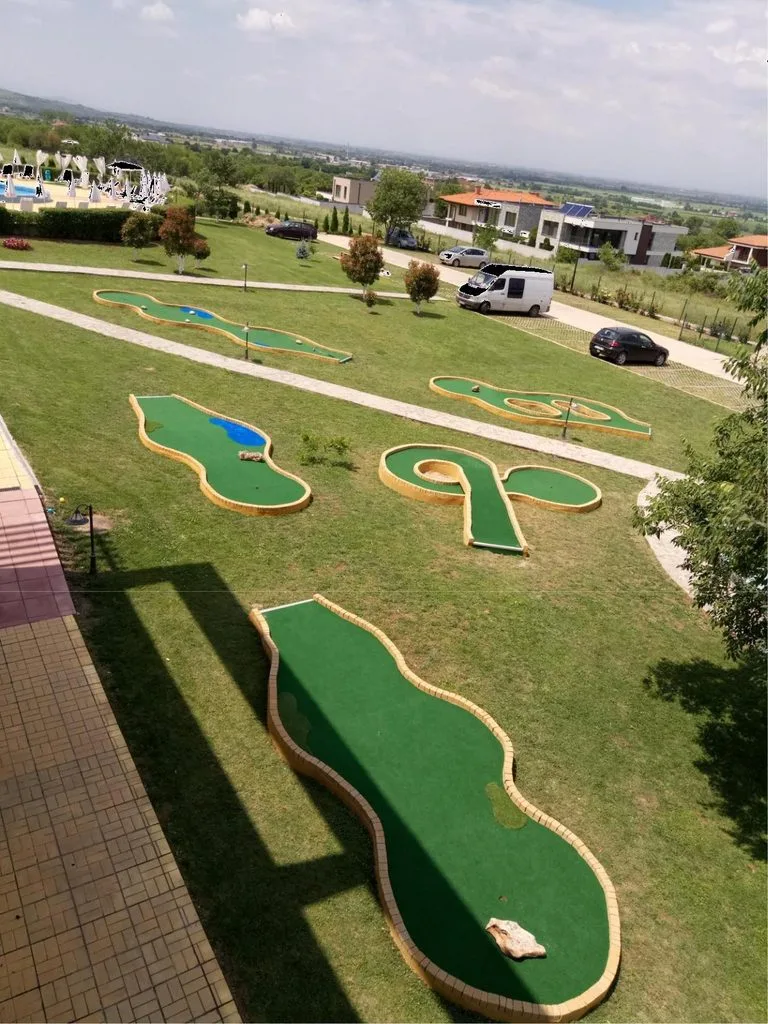
A permanent 9-hole course built directly into an open lawn plot — a durable installation once a site is confirmed.
Landscape-style “real golf” courses — the flagship investment
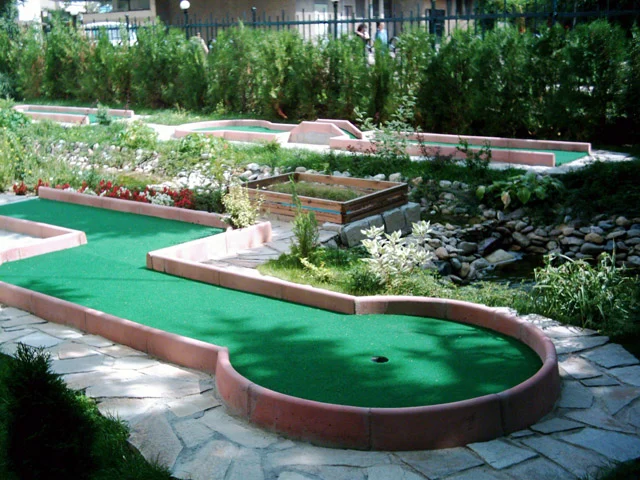
The most ambitious option recreates the look and feel of a real golf course in miniature: contoured greens, water features, planting, and winding paths connecting each hole, laid out across 1,900–3,200 m². This format suits entrepreneurs building a destination attraction rather than a side venue — a course designed to be the reason people visit, not just something they stumble across. It’s the format best suited to a larger, standalone leisure business, or a flagship addition to an existing entertainment park.
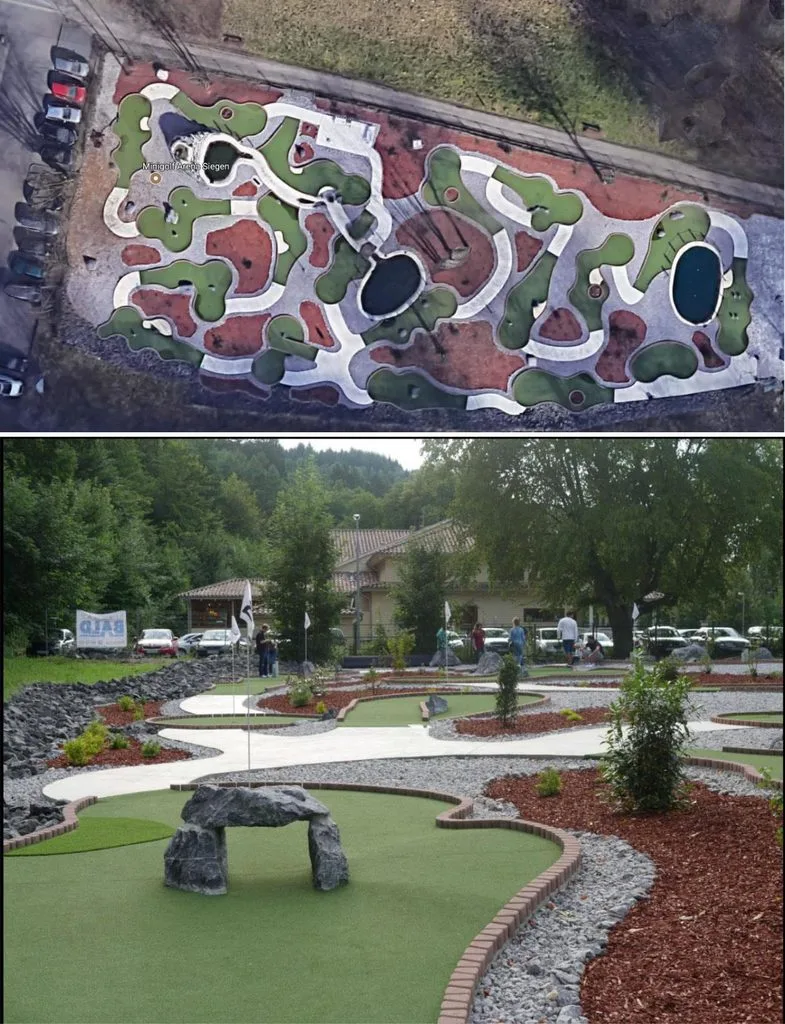
A landscape-style course built into natural stone and planting — designed to feel like a real golf course in miniature.
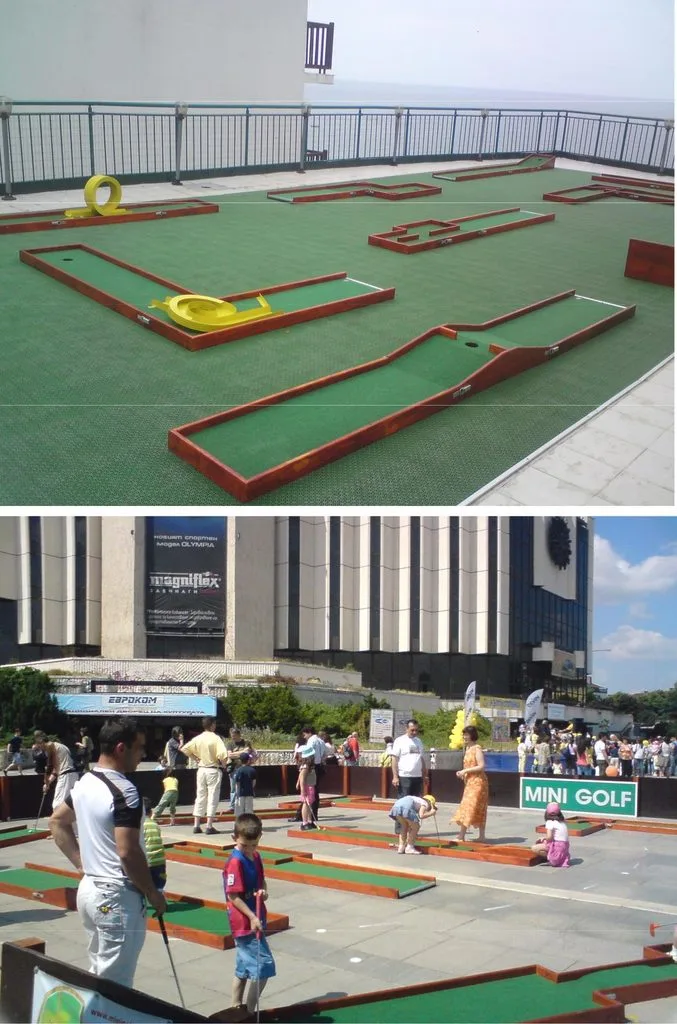
Even a compact portable course can make the most of a standout location, such as a rooftop or seafront terrace.
Choosing a Location: What to Look For
The location matters more than the course format itself — a well-sited compact course will outperform a large one in the wrong spot. A few principles apply across almost any site an entrepreneur might be considering:
- Foot traffic first — proximity to a beach, promenade, town square, shopping precinct, or another established attraction does more for revenue than course size.
- Visibility from the street — passers-by need to see the course to decide to play; a tucked-away plot needs strong signage to compensate.
- Line of sight for one attendant — a layout that a single staff member can oversee keeps running costs low.
- Flat or gently sloping ground — grass, sand, gravel, or paving all work with the right format; the metal portable course in particular is designed for uneven, ungraded land.
- Short or flexible lease terms — because portable formats aren’t fixed in place, they suit a leased plot where the entrepreneur wants the option to relocate if the site underperforms.
- Room to grow — a modest starting plot with adjoining space to expand later lets a small course grow into a larger one without relocating.
Built for Outdoor, Year-Round Use
Every format described here is designed specifically for outdoor operation, not adapted from an indoor product. Lanes and obstacles use weatherproof materials — water-resistant lacquered wood, galvanised steel, and durable artificial turf — so the course keeps performing through a full season of sun, rain, and constant footfall, which matters directly to an operator’s running costs. Permanent installations come with a multi-year workmanship guarantee, giving a new operator confidence that the investment holds up over several seasons, not just one.
From Design to Finished Course
Every project starts with the site itself: existing terrain, available space, and how the course should work for the intended customer are worked through directly with the operator before anything is built. That per-plot approach — rather than a catalogue layout dropped onto any site — is what separates a course that draws repeat business from one visitors walk past once and forget.
Behind the courses is over 20 years of hands-on mini golf design and construction experience, working with hotels, resorts, and independent operators across Bulgaria and abroad. Every course is personally designed to make the most of the space available, whether that’s a 30 m² rented corner or a 3,000 m² landscaped attraction — no guesswork, no costly surprises once the course is in place.
Frequently Asked Questions
How much space do I need to start a mini golf business?
It depends on the format. A portable wooden or metal 9-hole course can fit in as little as 30–200 m², making it possible to start on a small rented plot. Permanent courses need more — roughly 250–350 m² for 9 holes, 600 m²+ for 18 holes, and up to 3,000 m² for a full landscape-style course.
Do I need planning permission or construction work to open a course?
Not necessarily. Portable wooden and metal courses are freestanding and can be placed directly on a terrace, hardstanding, or grass — including uneven ground, thanks to adjustable levelling feet on the metal lanes. No groundworks are involved, which also makes them suited to leased or short-term sites. Permanent courses do involve built-in lanes and obstacles, so they follow a construction process, but this is handled from design through to completion.
Can I start small and expand later?
Yes. A common approach is to open with a compact portable course to test a location and prove demand, then reinvest in a larger permanent or landscape-style course once footfall and revenue justify it — or add a second course at a different site.
Can a course be set up on a rented or undeveloped plot?
Yes. The portable metal format is specifically designed for this — each lane has an adjustable levelling foot that keeps it stable and level on lawn, sand, or gravel, and because nothing is permanently built, the course can be relocated if a lease ends or a better site becomes available.
How much staff does a mini golf course need to run?
Very little. A single attendant can typically manage admissions, hand out putters and balls, and keep an eye on the course. No specialist training or licensing is required to operate one.
How long does it take to open a course from a standing start?
Portable courses can be delivered and installed in a matter of weeks, allowing a new operator to be taking paying customers well within a season. Permanent builds take longer, since they involve on-site preparation and construction, but timelines are agreed upfront.
Is mini golf a seasonal business only?
It depends on climate and location, but the appeal spans the full range of visitors — families, couples, tourists, and groups — for as long as outdoor conditions allow. Courses near ski resorts, coastal towns, and city parks all operate successfully within their own local season.
Get in Touch
Mini Golf Ltd designs and builds all six course formats described above, from small portable starter sets to full landscape-style attractions, for new operators, hotels, and holiday complexes.
Website: miniaturegolfplans.com