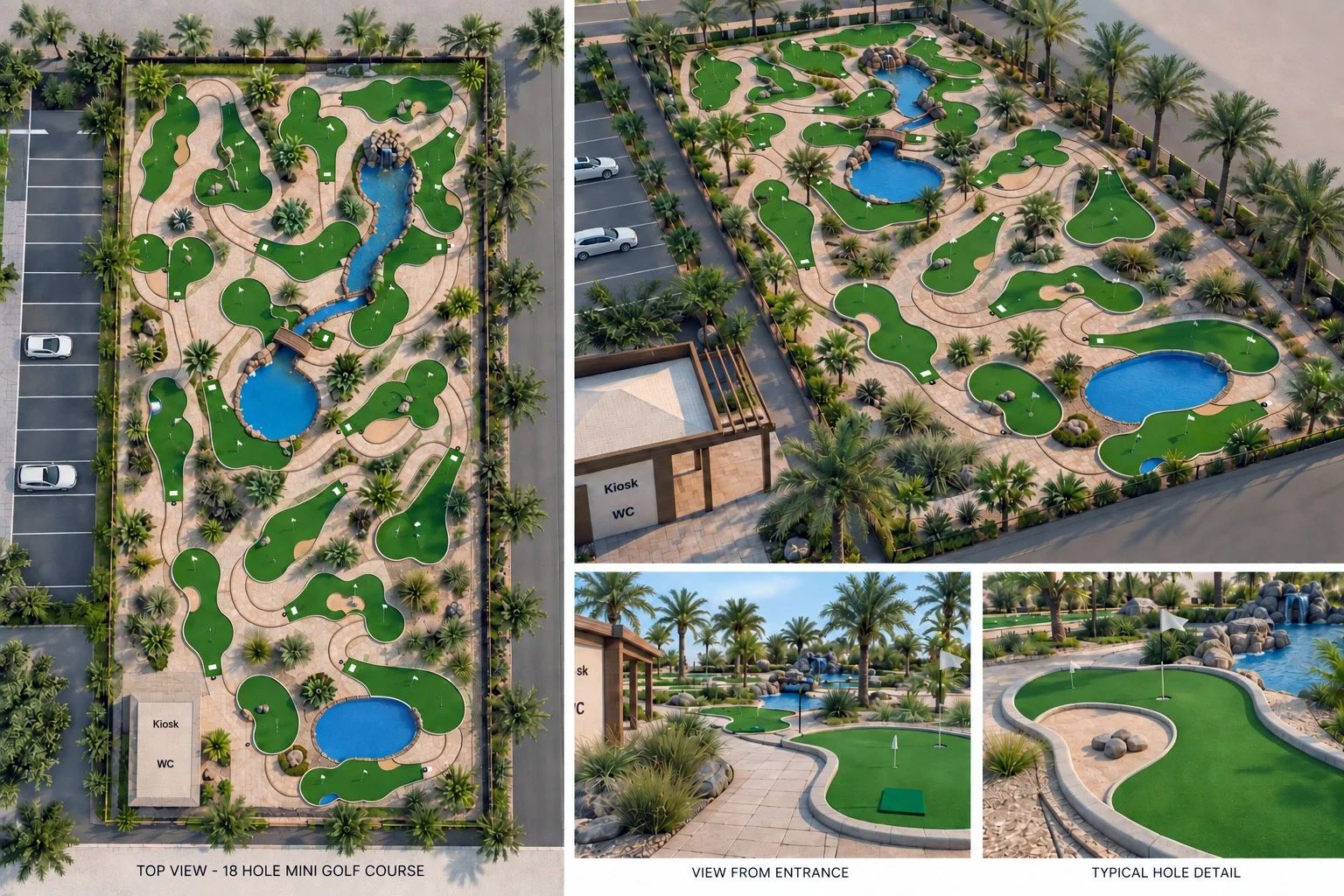
How to Start a Mini Golf Business: A 20-Step Guide from Idea to Opening Day
Starting a mini golf business can be much simpler and less expensive than many people assume.
You don’t necessarily need a huge property, an elaborate theme or a multimillion-dollar adventure golf course. With good planning, an efficient layout and proper construction drawings, a smaller mini golf course can become a viable attraction for an independent business, hotel, campsite, resort, restaurant or family entertainment venue.
The key is to plan the business and the course together.
Here are the 20 steps I recommend taking before opening your mini golf course.
1. Decide What Type of Mini Golf Business You Want
The first decision isn’t what obstacles to buy. It is what type of business you want to create.
Your main options include:
- Standalone outdoor mini golf
- Mini golf added to an existing business
- Indoor mini golf
- Blacklight or glow mini golf
- Adventure golf
- Compact traditional mini golf
- Portable or modular mini golf
An existing hotel, campsite, restaurant, amusement venue or leisure business has an important advantage: it already has customers.
For these businesses, mini golf doesn’t necessarily have to support the entire operation by itself. It can increase visitor spending, extend the length of stay and provide an additional activity.
2. Identify Your Customers
Who will actually play?
Potential customers include:
- Families with children
- Tourists
- Couples
- Teenagers
- Hotel guests
- Campsite visitors
- School groups
- Birthday parties
- Corporate groups
Your target customer influences everything from hole difficulty to theming, ticket price and opening hours.
A family course should not be designed in exactly the same way as an indoor entertainment venue aimed primarily at young adults.
3. Research Your Local Market
Before investing money, investigate the area.
Look at:
- Population
- Tourist numbers
- Hotels and campsites
- Family attractions
- Shopping and entertainment areas
- Existing mini golf courses
- Ticket prices at competing attractions
- Seasonal visitor patterns
Don’t research mini golf competitors alone.
A trampoline park, bowling centre, escape room, amusement park or children’s attraction may compete for exactly the same leisure spending.
4. Estimate Potential Customer Numbers
Avoid starting with an optimistic revenue number.
Start with customers.
Estimate attendance separately for weekdays, weekends, holidays and different seasons.
Then create three scenarios:
Conservative – Expected – Optimistic
For example:
10,000 annual players × €8 average admission = €80,000
20,000 players × €8 = €160,000
30,000 players × €8 = €240,000
These aren’t promises of what a particular course will earn. They demonstrate why customer volume is one of the most important assumptions in your feasibility study.
5. Calculate Your Break-Even Point
Before building, determine approximately how many paying customers you need.
A useful simplified formula is:
Contribution per player = average revenue per player – variable cost per player
Then:
Break-even players = fixed costs ÷ contribution per player
Include rent or financing, wages, insurance, utilities, marketing, maintenance, taxes and other recurring expenses.
A course that looks profitable at 30,000 customers but loses money at 12,000 customers may be a considerably riskier investment than it initially appears.
6. Determine How Much Land You Need
There is no single correct amount of land for every mini golf course.
The requirement depends on:
- Number of holes
- Hole dimensions
- Landscaping
- Paths
- Reception
- Toilets
- Parking
- Seating
- Theme elements
- Local regulations
A well-designed compact course can use land much more efficiently than a poorly planned course.
This is particularly important for small businesses where land is limited or expensive.
7. Decide Between 9 and 18 Holes
Eighteen holes remain the traditional format for a complete standalone mini golf experience.
But 9 holes can make excellent commercial sense when:
- Space is limited
- The budget is smaller
- Mini golf is an additional attraction
- Customers have several activities available
- You want to test the concept before expanding
Don’t automatically build 18 holes simply because it is traditional.
Build the number of holes that makes sense for your site and business model.
8. Choose the Right Course Type
There is a major cost difference between a relatively simple miniature golf course and heavily themed adventure golf.
A traditional course can use:
- Concrete
- Artificial grass
- Metal obstacles
- Simple landscaping
- Timber or masonry borders
An adventure golf course might include:
- Artificial rocks
- Waterfalls
- Bridges
- Caves
- Large themed structures
- Extensive landscaping
- Special lighting
Both can provide an enjoyable game.
The right choice depends on your market and investment budget.
9. Set Your Maximum Investment Budget
Establish your budget before the final design.
Separate it into categories:
- Site preparation
- Drainage
- Course construction
- Playing surfaces
- Obstacles
- Landscaping
- Lighting
- Electrical work
- Reception
- Toilets
- Furniture
- Clubs and balls
- Signs
- Professional fees
- Marketing
- Contingency
This makes it much easier to value-engineer the project without compromising the fundamental course.
10. Check Planning, Zoning and Permits
Do this before committing to construction.
Requirements differ significantly between countries and municipalities.
Depending on the project, you may need approval relating to:
- Land use
- Building works
- Accessibility
- Electrical installation
- Signs
- Parking
- Toilets
- Food service
- Fire regulations
- Public liability
- Water features
Speak to the relevant local authorities and qualified local professionals before construction.
11. Survey the Site
You cannot properly design a site-specific course without understanding the property.
Record:
- Exact boundaries
- Existing levels
- Slopes
- Buildings
- Trees
- Utility locations
- Entrances
- Drainage
- Existing paths
- Parking
- Features that must remain
Even relatively small errors at this stage can become expensive during construction.
12. Create the Overall Course Layout
Now the actual mini golf design begins.
The layout needs to fit the individual holes together while providing good circulation.
A good layout considers:
- Player flow
- Hole sequence
- Queuing
- Safety
- Visibility
- Landscaping
- Maintenance access
- Emergency access
- Drainage
- Space between groups
Trying to fit as many holes as possible into the available land isn’t necessarily good design.
Efficient use of space is important, but the course still needs to feel comfortable.
13. Design Every Hole for Playability
Every hole needs a purpose.
Use combinations of:
- Banks
- Slopes
- Curves
- Tunnels
- Ramps
- Bridges
- Multiple routes
- Rebounds
- Obstacles
Difficulty should vary throughout the course.
Avoid creating 18 variations of the same straight putt.
A good hole gives the player something to think about while still being understandable to someone playing mini golf for the first time.
14. Create a Few Signature Holes
You don’t need to make every hole expensive.
Instead, consider putting more visual impact into a few memorable locations.
A distinctive final hole, themed obstacle, bridge, sculpture or other feature can become something customers photograph and share.
The remaining holes can concentrate on good gameplay.
This can produce a much stronger course without dramatically increasing the construction budget.
15. Produce Construction-Ready Plans
This is one of the most important stages.
Don’t expect a general building contractor to invent the mini golf course while constructing it.
Your documentation should give contractors enough information to understand what they are supposed to build.
Depending on the project, this can include:
- Overall layout
- Individual hole drawings
- Dimensions
- Levels and slopes
- Construction sections
- Border details
- Drainage
- Artificial-grass specifications
- Obstacle locations
- Material specifications
- Landscaping information
Good drawings allow ordinary local contractors to quote the work more accurately and reduce improvisation during construction.
16. Obtain Construction Quotes
Once you have proper plans, ask local contractors to price the project.
This is much more useful than asking:
“How much does a mini golf course cost?”
There is no meaningful universal answer.
Construction prices vary enormously according to country, labour rates, site conditions, course style, landscaping and theme.
Detailed plans let contractors price approximately the same scope of work, making quotations much easier to compare.
17. Build the Course in the Correct Sequence
Although every project is different, construction commonly progresses through stages such as:
Setting out → earthworks → drainage → foundations/sub-base → hole construction → concrete work → utilities → obstacles → playing surfaces → paths → landscaping → signage → finishing
Drainage deserves particular attention on outdoor courses.
Beautiful artificial grass and expensive obstacles won’t compensate for a course that retains water after rain.
18. Test Every Hole Before Opening
Construction completion doesn’t necessarily mean the course is ready.
Play every hole repeatedly.
Test:
- Easy shots
- Difficult shots
- Bank shots
- Accidental shots
- Ball escape points
- Bottlenecks
- Putting speed
- Slopes
- Drainage
- Safety
Get children and inexperienced players to test it too.
A designer or experienced player may take a route through a hole that an ordinary customer never sees.
19. Create Multiple Revenue Streams
Admission doesn’t have to be your only income.
Consider:
- Family tickets
- Birthday parties
- Corporate events
- School groups
- Tournaments
- Food and drinks
- Ice cream
- Merchandise
- Sponsorship
- Season passes
- Combination tickets with another attraction
This is particularly powerful when mini golf is part of an existing hotel, campsite, restaurant or entertainment business.
20. Start Marketing Before Opening Day
Your marketing should begin while the course is being built.
Show people the transformation:
Empty land → construction → first holes → obstacles → artificial grass → landscaping → completed course
This gives you months of content for Facebook, Instagram, TikTok, YouTube and your website.
Before opening, prepare:
- Website
- Google Business Profile
- Social media pages
- Professional photographs
- Online booking if appropriate
- Opening promotion
- Local partnerships
- Hotel/tourism partnerships
- School and corporate offers
And encourage reviews immediately after opening.
How Much Does It Cost to Start a Mini Golf Business?
There is no reliable universal figure.
Two 18-hole courses can have dramatically different budgets.
A compact course built by local contractors using straightforward construction and prefabricated obstacles is fundamentally different from a heavily landscaped adventure golf course with waterfalls, artificial mountains and large themed structures.
Your biggest cost drivers are normally:
Land + site preparation + construction + theming + landscaping + buildings + infrastructure + labour.
This is why I recommend designing to a target budget instead of designing the dream course first and discovering afterwards that it cannot be afforded.
Can You Build a Mini Golf Course Yourself?
Yes — at least partly.
You don’t necessarily need a specialist mini golf construction company to perform every stage of the work.
Excavation, concrete, drainage, electrical work, landscaping and many other jobs can often be completed by competent local contractors.
The critical difference is having proper plans and specifications showing them what to build.
That’s where DIY construction can save considerable money without turning the project into guesswork.
The Biggest Mistake When Starting a Mini Golf Business
In my experience, one of the biggest mistakes is starting construction too early.
An owner has land.
They know roughly where the holes should go.
A local builder is available.
So construction begins.
Then questions appear:
How wide should this hole be?
Where should the ball go?
What slope do we need?
Where does the water drain?
Will 18 holes actually fit?
Changing these things on paper is inexpensive.
Changing concrete after it has been built isn’t.
Design First. Build Second.
A successful mini golf course isn’t simply 9 or 18 putting greens placed on a property.
It is a small entertainment system.
The business model, customer flow, hole design, construction method, operating costs and marketing all need to work together.
You also don’t necessarily need the budget of a large adventure-golf developer.
With an efficient layout, proper construction plans and suitable local contractors, a small business can create a professional mini golf attraction at a much more manageable investment.
Need Help Planning Your Mini Golf Course?
I am Stan Stoyanov, founder of Mini Golf Ltd – Bulgaria, and I have been designing and building miniature golf courses for approximately 20 years.
My work is particularly focused on projects that are often too small or budget-conscious for the large international mini golf construction companies.
I can help you with:
- Site-specific mini golf course design
- 9-hole and 18-hole layouts
- Construction drawings
- DIY construction plans
- Material specifications
- Pre-designed course plans
- Custom-made mini golf obstacles
- Advice for building the course with your own local contractors
The objective is simple:
Give you enough professional information to build locally — without paying for an expensive international turnkey construction company.
If you already have a potential site, the best starting point is a site plan showing its dimensions.
From there, we can determine what type of mini golf course can realistically fit your property.