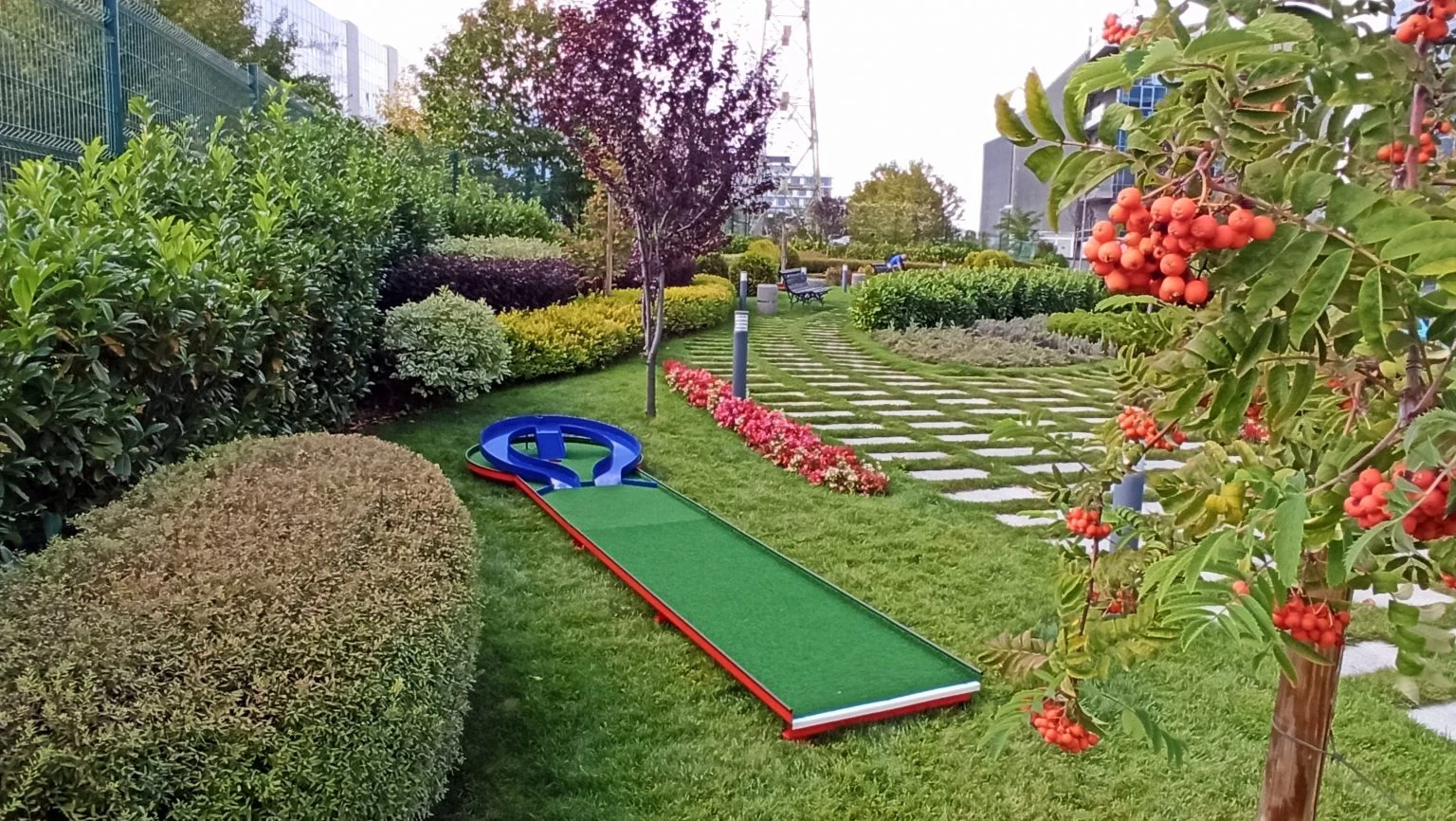
Business figures and historical examples in this guide are illustrative. Your results depend on your location, visitor demand, costs and operation; request current local quotations before making investment decisions.
Mini Golf for Campsites: A Practical Guide to Adding a Course Your Guests Will Actually Use
Mini golf is one of the few campsite attractions that pays for itself in guest satisfaction almost immediately. It needs no lifeguard, no power supply, and — depending on the format you choose — no construction at all. This guide explains what campsite and holiday-park owners need to know before adding a course: how much space it really takes, which of the available formats fits a given site, how the courses hold up outdoors, and what it takes to have one running before the next season starts.
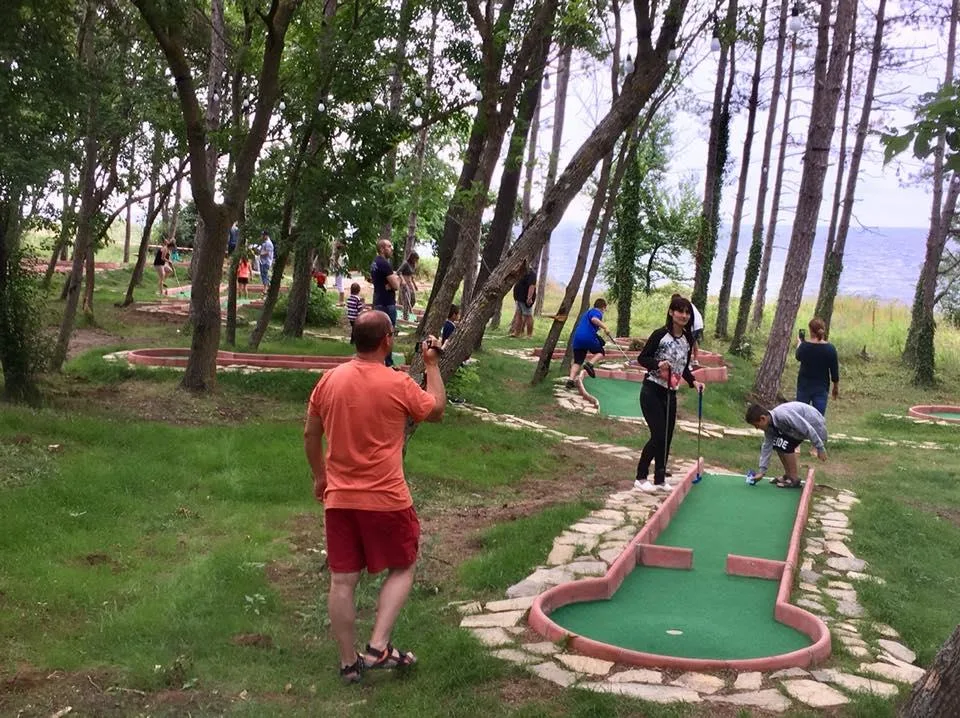
A permanent course set among trees, close to the water — mini golf blends naturally into a campsite’s existing landscape.
Why Campsites Add Mini Golf
Campsites and holiday parks compete on how families spend their downtime. Guests with children are looking for something to do between the beach, the pool, and dinner — an activity that doesn’t require booking, supervision, or extra staff. Mini golf fills exactly that gap.
- Low supervision — guests play unattended once putters are handed out at reception.
- All ages and abilities — a single course entertains toddlers through grandparents.
- Weather-tolerant — outdoor formats are built for sun, rain, and heavy foot traffic.
- Extra revenue with minimal overhead — a small per-round or per-hour charge, or simply a value-add included in the stay.
- A stronger listing — a mini golf course is the kind of feature that shows up in reviews and photos, and gives families a reason to choose one site over another.
For parks working with international tour operators, an on-site activity like mini golf can also help meet entertainment and sports requirements bundled into all-inclusive packages — again, without needing a swimming pool’s worth of investment or staffing.
Which Course Format Fits Your Site
Not every campsite has the same amount of space, budget, or willingness to dig up the ground. Six formats cover the realistic range of what a campsite or holiday park might need, from a compact 30 m² corner to a full landscaped attraction.
| Course format | Footprint needed | Setup | Best suited to |
| Portable wooden 9-hole | From ~30 m² | Freestanding lanes, no groundworks | Small pitches, terraces, seasonal parks |
| Portable metal 9-hole | From ~200 m² | Galvanised lanes with adjustable levelling feet | Grass, sand, gravel — anywhere uneven |
| Larger portable 9-hole (~96 m²) | ~96 m² | Wider lanes, more spacious layout | Sites with a bit more room to spare |
| Permanent 9-hole | From ~250–350 m² | Built-in obstacles, artificial turf, edging | Sites wanting a fixed, year-round attraction |
| Permanent 18-hole | From ~600 m² | Full-scale built course, two loops of nine | Larger campsites and resort-style parks |
| Landscape-style “real golf” 9-hole | ~1,900–3,200 m² | Contoured greens, ponds, planting, winding paths | Flagship attractions and premium holiday parks |
Portable wooden courses — for tight spaces
The smallest format needs as little as 30 m² for a full 9 holes, with each lane roughly 3 metres long. It is fully weatherproof, built for outdoor use, and requires zero groundworks — the lanes simply sit on any reasonably flat surface: a terrace, a corner of the pitch area, next to the pool, or even indoors during a rainy afternoon. Despite the compact size, each lane is designed with an obstacle that keeps the game genuinely challenging rather than trivial.
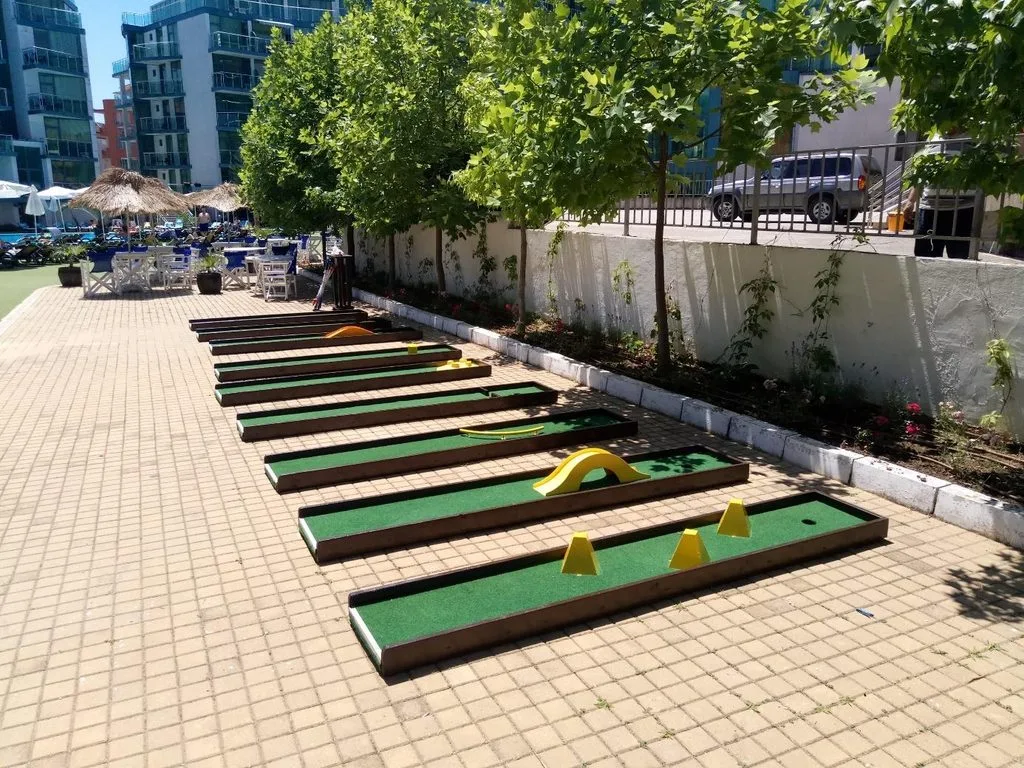
A portable wooden 9-hole course set up beside the pool terrace — no construction, no fixed installation.
Portable metal courses — built for grass, sand, and uneven ground
Where a site is grassy, sandy, or simply not perfectly level, the galvanised metal format is the better fit. Each lane comes with an adjustable levelling foot, so the course can be placed directly on lawn, gravel, or a beach area and still sit dead level for play — without a single spade of groundwork. The metal construction is fully weatherproof and holds up to being watered along with the surrounding lawn.
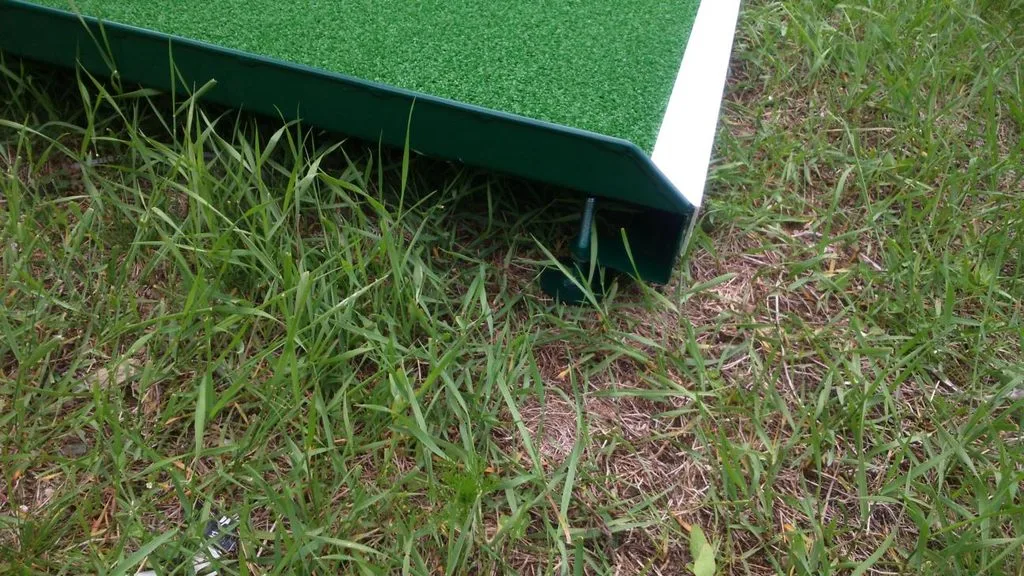
Adjustable levelling feet let a metal lane sit level on grass — set up directly on turf with no groundworks required.
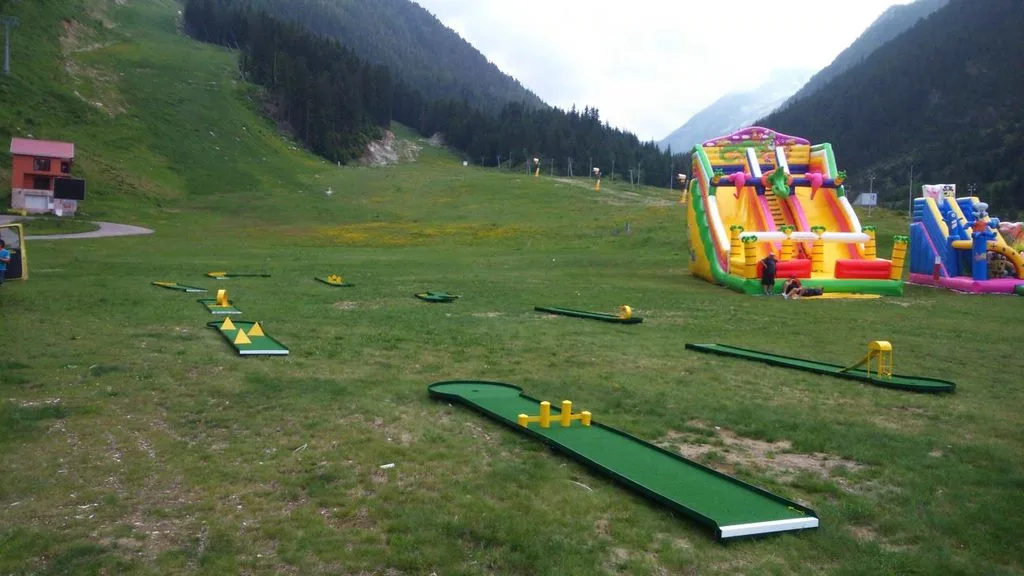
A portable metal course set up on an open meadow alongside other holiday-park attractions.
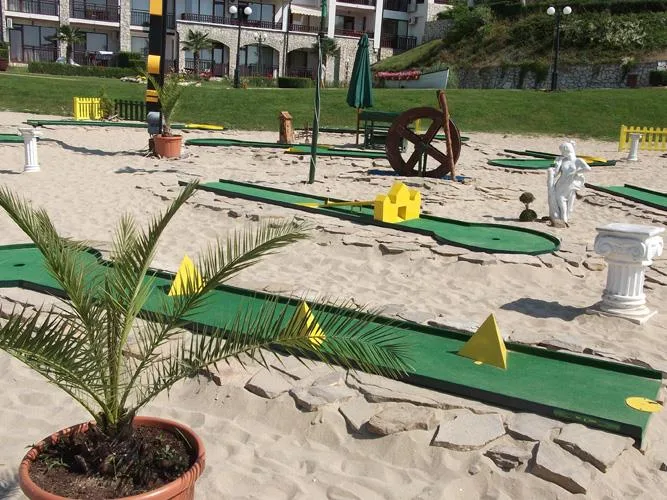
Metal lanes can be themed and installed directly on sand — a popular option for beachfront resorts.
Permanent courses — a fixed, year-round attraction
For campsites that want mini golf as a permanent fixture rather than a seasonal setup, the 9-hole and 18-hole permanent formats are built in place: concrete or built-up lanes, artificial turf, and integrated obstacles designed to the standards used by international minigolf federations. A permanent 9-hole course needs roughly 250–350 m², while an 18-hole course needs around 600 m² or more. These courses are engineered for continuous outdoor use and require very little upkeep beyond routine care of the turf.
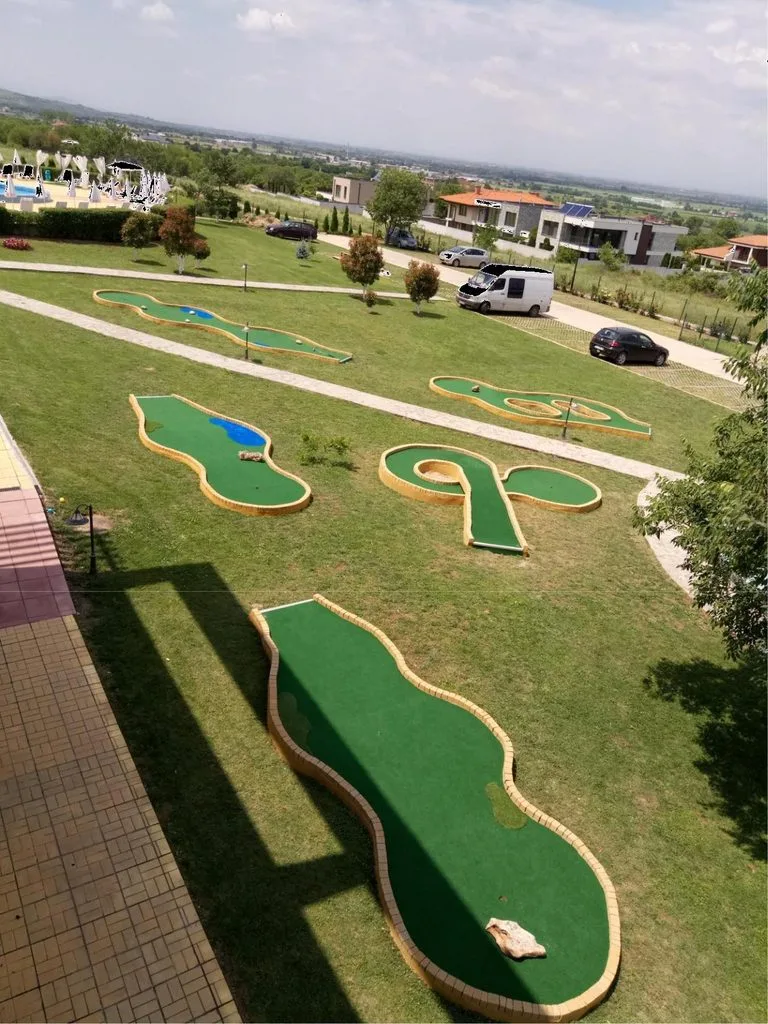
A permanent 9-hole course built directly into an open lawn area.
Landscape-style “real golf” courses — a flagship attraction
The most ambitious option recreates the look and feel of a real golf course in miniature: contoured greens, water features, planting, and winding paths connecting each hole, laid out across 1,900–3,200 m². This format suits larger holiday parks and resorts that want mini golf to be a headline attraction in its own right rather than a side activity — the kind of feature that appears in the park’s own marketing photos.
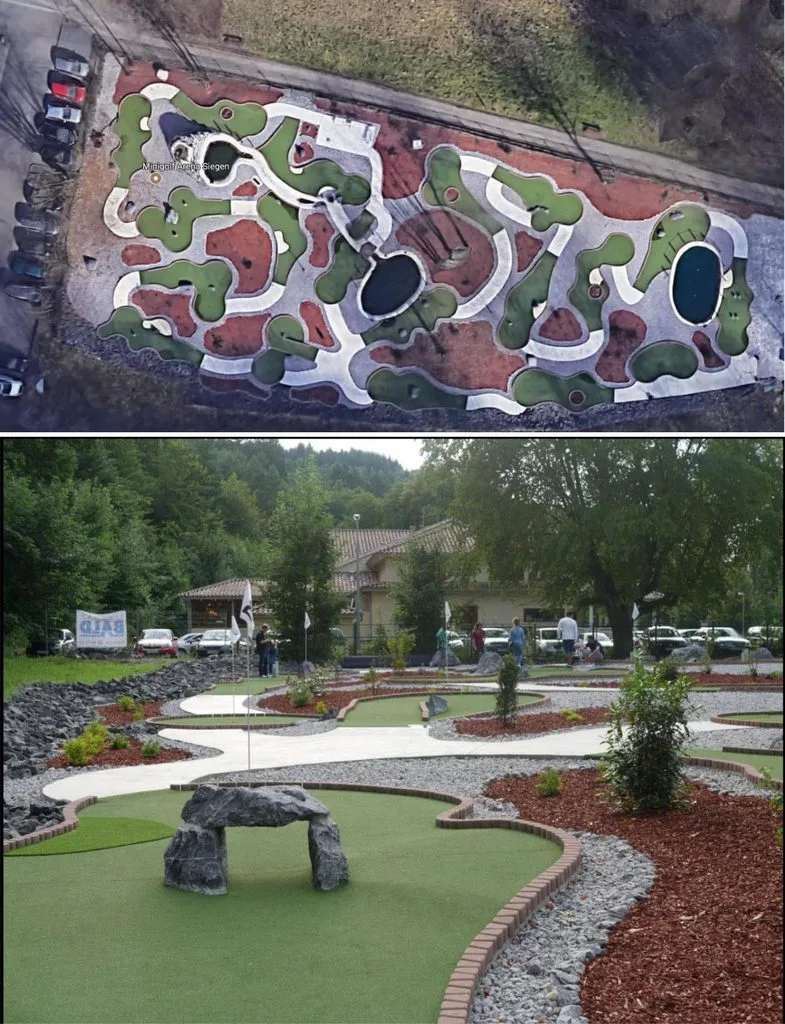
A landscape-style course built into natural stone and planting — designed to feel like a real golf course in miniature.
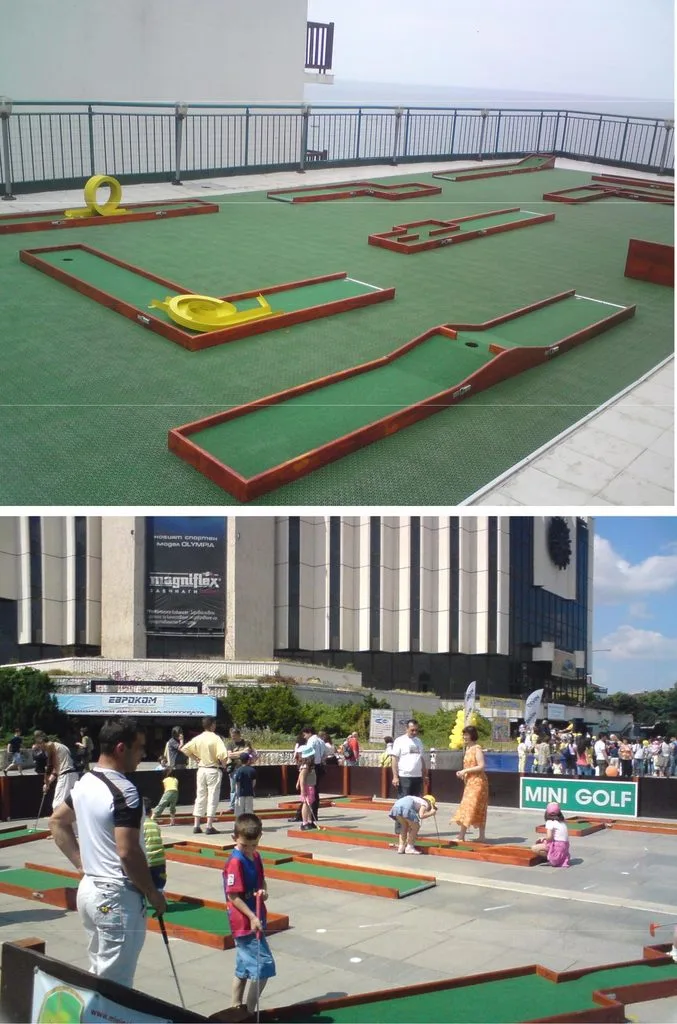
Even a compact portable course can make the most of a standout location, such as a rooftop or seafront terrace.
Where to Put It: Siting Principles for Campsites
Getting the location right matters more than the course format itself. A few principles apply across almost every campsite layout:
- Near the pool or restaurant — locations where parents are already seated and can keep half an eye on play tend to get the most use.
- Reception-adjacent — if putters are collected and returned at reception, no separate staffing is needed at the course itself.
- Underused indoor space — conference or function rooms that sit empty during the peak family season can host a portable course without any change to the room itself.
- Grass areas — the metal portable format is specifically designed to sit on lawn, including areas that are watered daily, without affecting the course.
- Flexible relocation — because portable formats aren’t fixed in place, a course can be moved between a winter storage spot and a summer location, or reconfigured as the site evolves.
Built for Outdoor, Year-Round Use
Every format described here is designed specifically for outdoor operation, not adapted from an indoor product. Lanes and obstacles use weatherproof materials — water-resistant lacquered wood, galvanised steel, and durable artificial turf — so the course keeps performing through a full holiday season of sun, rain, and constant footfall. Permanent installations come with a multi-year workmanship guarantee, giving campsite operators confidence that the investment holds up over several seasons, not just one.
From Design to Finished Course
Every project starts with the site itself: existing terrain, available space, and how the course should connect with the rest of the park are worked through directly with the owner before anything is built. That per-plot approach — rather than a catalogue layout dropped onto any site — is what separates a course guests remember from one they simply walk past.
Behind the courses is over 20 years of hands-on mini golf design and construction experience, working with hotels, resorts, and holiday parks across Bulgaria and abroad. Every course is personally designed to make the most of the space available, whether that’s a 30 m² terrace corner or a 3,000 m² landscaped attraction — no guesswork, no costly surprises once the course is in place.
Frequently Asked Questions
How much space does a campsite need for mini golf?
It depends on the format. A portable wooden or metal 9-hole course can fit in as little as 30–200 m², making it viable even for small sites. Permanent courses need more — roughly 250–350 m² for 9 holes, 600 m²+ for 18 holes, and up to 3,000 m² for a full landscape-style course.
Does adding a mini golf course require construction or planning permission?
Not necessarily. Portable wooden and metal courses are freestanding and can be placed directly on a terrace, hardstanding, or grass — including uneven ground, thanks to adjustable levelling feet on the metal lanes. No groundworks are involved. Permanent courses do involve built-in lanes and obstacles, so they follow a construction process, but this is handled from design through to completion.
Can a mini golf course be set up directly on grass?
Yes. The portable metal format is specifically designed for this — each lane has an adjustable levelling foot that keeps it stable and level on lawn, sand, or gravel, and the material tolerates regular watering of the surrounding grass.
How long does it take to get a course up and running?
Portable courses can be delivered and set up in a matter of weeks. Permanent builds take longer, since they involve on-site preparation and construction, but timelines are agreed upfront so a course can realistically be ready before the start of the season.
Is mini golf suitable for guests of all ages?
Yes — this is one of its main advantages as a campsite attraction. A single course entertains toddlers, teenagers, and grandparents at the same time, with no special skill, fitness, or supervision required.
Can an indoor space, like a conference room, be used for mini golf?
Yes. Portable wooden courses are compact and freestanding, which makes them a practical way to make use of conference or function rooms that often sit underused during the peak family holiday season.
Get in Touch
Mini Golf Ltd designs and builds all six course formats described above, from small portable sets to full landscape-style attractions, for campsites, holiday parks, and hotels.
Website: miniaturegolfplans.com Email: backyardminigolf@yahoo.com